


The UK’s future rules for sharing air traffic management information are taking shape. Airlines, operators and technology providers have until 6 January 2027 to comment on the Civil Aviation Authority’s proposed approach to System Wide Information Management (SWIM).
The consultation, launched on 6 October, is an early step towards a regulatory framework that the CAA expects to develop alongside amendments to UK air traffic management and air navigation services requirements.
From Consultation to Regulation
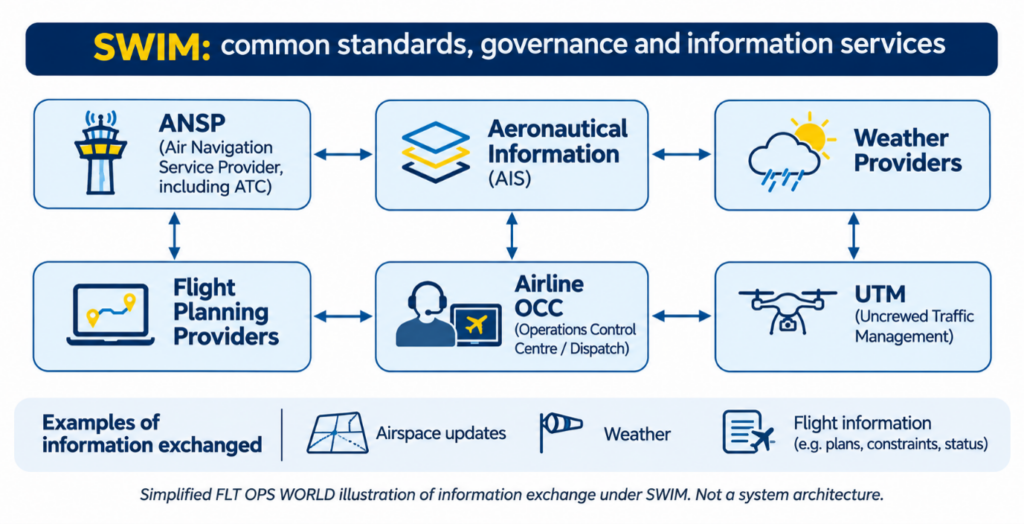
SWIM is not a single software platform. It establishes standards, infrastructure and governance intended to make aviation information easier to discover, access and exchange between different systems.
The CAA has published three preliminary documents covering the implementation framework, technical architecture and example operational scenarios.
Its initial work has focused on integrating uncrewed aircraft operations, particularly beyond visual line of sight (BVLOS) operations, into the wider aviation system.
The technical architecture establishes high-level principles for all aviation stakeholders but acknowledges that further work is needed to address crewed aviation in detail.
The CAA plans to publish updated technical architecture and operational scenarios specifically covering crewed aviation users in 2027.
A formal first version of the SWIM Implementation Framework is targeted for 2028. The CAA expects this to align with a rulemaking task to amend ATM/ANS requirements, including provisions governing how relevant stakeholders apply the framework.
Its implementation roadmap outlines a route from rulemaking and consultation to legislative amendments and a statutory instrument.
The preliminary documents establish implementation milestones, particularly for uncrewed operations, but do not specify a compliance deadline for conventional airline operators.
Where the Regulatory Boundary Could Fall
The draft technical architecture identifies several roles within the information-sharing system, including organisations that originate information, provide information services and consume those services. An organisation may perform more than one role.
But identifying a technical role is not the same as deciding which organisations must meet future regulatory requirements.
An airline receiving operational data through a flight planning provider may face different responsibilities from a company publishing information directly into the SWIM environment.
The consultation does not yet establish where those regulatory boundaries will fall.
The Operational Decisions Behind the Standards
An airspace restriction might need to reach an air navigation service provider, a flight planning system and an airline’s operations control centre.
Common standards could make that information easier to exchange consistently. They would not automatically determine how quickly a flight planning application processes the update, whether a dispatcher receives an alert or when a revised route is calculated.
The current consultation is therefore an opportunity for operators and suppliers to raise practical questions about information availability, service responsibilities and system integration before the regulatory framework is finalised.
The CAA has already described the direction of travel towards rulemaking. What remains open is how far the resulting requirements will reach into the systems used to plan and manage flights.