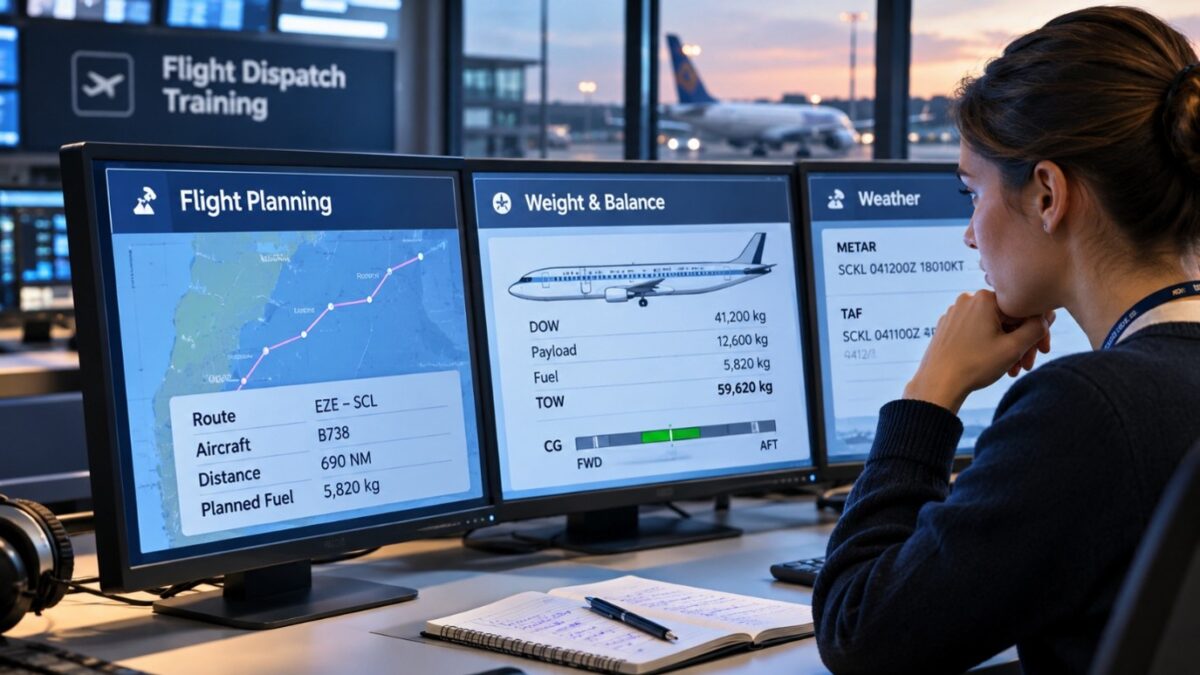


A flight plan can be mathematically correct and still leave an aircraft outside its permitted weight-and-balance limits. For flight dispatchers, understanding how fuel, payload and aircraft loading interact is just as important as producing the flight plan itself.
A newly reported training platform called OPERDAT Training aims to help aviation students understand these operational relationships through connected flight planning and aircraft loading exercises.
Developed by Argentine flight dispatcher and aviation instructor Marcos Tehaux, the web-based teaching environment was featured in a report published on 4 November 2026 by aviation training publication Halldale.
Understanding the Decisions Behind a Flight Plan
OPERDAT Training brings flight planning, fuel calculations and weight-and-balance exercises into a connected educational workflow.
Students can prepare a simulated flight plan and use information from that exercise to complete a passenger or freighter loadsheet.
One distinctive feature is the manual transfer of information between exercises.
Rather than automatically transferring every calculation, the training process requires students to identify relevant figures and understand how they affect subsequent operational decisions.
Consider a flight where an increase in planned fuel reduces the payload available within the aircraft’s permitted weight limits.
Or a cargo operation where total aircraft mass remains acceptable, but the distribution of freight creates a centre-of-gravity problem.
These examples illustrate the relationships dispatcher students must understand, rather than specific exercises independently verified within OPERDAT.
Passenger, Cargo and Weather Planning
The platform includes training exercises covering both passenger and freighter operations.
This distinction is important because passenger operations involve managing passenger loads, baggage and associated loading assumptions, while cargo operations may require more detailed consideration of freight distribution and loading positions.
The training environment also provides access to METAR and TAF weather information, allowing instructors to incorporate aviation weather interpretation into planning exercises.
Together, these functions are intended to help students understand how different elements of flight preparation influence one another.
Teaching Operational Understanding, Not Replacing Dispatch Systems
OPERDAT Training is presented as an educational environment intended to complement instructor-led training and existing course materials.
It should not be confused with an approved operational flight planning or aircraft load-control system.
The developer is seeking feedback from aviation training organisations through guided demonstrations, with the aim of exploring how the exercises could fit into existing curricula.
FLT OPS WORLD has not independently confirmed customer deployments, regulatory training approvals or measured improvements in student performance.
The platform’s practical capabilities and training outcomes remain to be independently evaluated.
Why This Matters for Dispatcher Training
Airline operational control increasingly depends on specialised software that calculates fuel requirements, prepares flight plans and exchanges information between operational departments.
While automation improves efficiency, dispatchers still need to understand the calculations, assumptions and operational limitations behind the information presented to them.
A training environment that deliberately requires students to connect these calculations could provide a useful complement to conventional classroom instruction.
Whether OPERDAT achieves that objective in practice will depend on its implementation, instructional quality and feedback from training organisations.
The underlying training principle is important: future dispatchers must learn not only how to produce a flight plan, but how changes to fuel, payload, weather and aircraft loading affect the safety and feasibility of the entire operation.