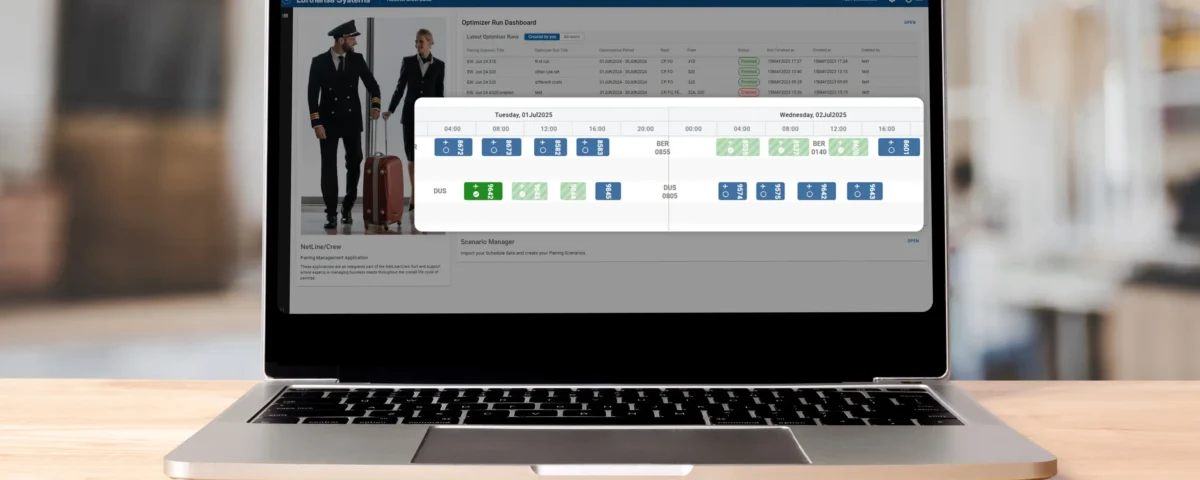

As airlines continue to navigate growing operational complexity, workforce constraints, and increasing pressure to control costs, efficient crew planning has become one of the most critical components of airline operations. Recognizing this challenge, Lufthansa Systems has unveiled its new NetLine Crew Pairing Application, a cloud-native solution designed to modernize how airlines create, evaluate, and optimize crew pairings.
The new application represents a significant addition to the company’s well-established NetLine portfolio and aims to help airlines improve pairing quality, reduce operational costs, and enhance planning flexibility through advanced optimization capabilities and scalable cloud technology.
As crew costs remain one of the largest operational expenses for airlines, tools capable of generating more efficient and resilient crew schedules are attracting increased attention across the industry.
Addressing One of Aviation’s Most Complex Planning Challenges
Crew pairing sits at the heart of airline resource planning.
Every day, airlines must create legally compliant pairing sequences that connect thousands of flights while balancing regulatory requirements, crew qualifications, labor agreements, hotel accommodation needs, positioning flights, and operational disruptions.
The challenge becomes even more complex as schedules evolve and airlines seek to maximize crew utilization without compromising resilience.
According to Jan-Peter Gaense, Senior Vice President NetLine & SIRAX at Lufthansa Systems, the new solution has been specifically developed to address these growing challenges.
“Crew pairing is one of the most complex challenges in airline resource planning. Our new NetLine Crew Pairing Application brings together the latest cloud-native technology and user-centric design to give airlines more control, speed, and flexibility.”
He described the launch as a major milestone for both the NetLine portfolio and the ongoing modernization of the NetLine Crew product suite.
Built for the Cloud Era of Airline Operations
One of the application’s defining characteristics is its cloud-native architecture.
Unlike many legacy airline planning systems that were originally developed for on-premise environments, the new NetLine Crew Pairing Application has been designed specifically to take advantage of cloud scalability, performance, and accessibility.
For airlines, this approach offers several potential benefits:
- Greater scalability during intensive planning cycles.
- Improved system performance for complex optimization calculations.
- Enhanced accessibility for distributed planning teams.
- Faster deployment and system updates.
- Increased operational flexibility.
As airlines increasingly pursue digital transformation initiatives across their operational environments, cloud-native solutions are becoming a key component of long-term technology strategies.
Advanced Optimization at the Core
The centerpiece of the new application is its integrated optimization engine.
Traditionally, crew planners have often relied on a combination of automated tools and manual intervention to construct pairing solutions. However, growing schedule complexity and operational constraints have increased the need for more sophisticated optimization capabilities.
The NetLine Crew Pairing Application incorporates built-in optimization algorithms that allow airlines to automatically evaluate and generate pairing solutions while balancing operational requirements and cost objectives.
The system is designed to help airlines achieve:
- Improved pairing efficiency.
- Reduced crew scheduling costs.
- Lower hotel expenses.
- Reduced positioning costs.
- More robust operational plans.
By automating much of the evaluation process, airlines can potentially identify opportunities that may be difficult or impossible to find through manual analysis alone.
Scenario Planning for Better Decision-Making
One of the more powerful capabilities introduced with the new application is its ability to evaluate multiple crew pairing scenarios simultaneously.
Airline planners frequently face trade-offs between cost, operational flexibility, crew utilization, and disruption resilience. Rather than committing immediately to a single option, the application enables planners to compare multiple solutions side by side before selecting the most appropriate outcome.
This scenario-based approach supports more informed decision-making and allows planning teams to assess the potential impact of different assumptions or operational priorities.
As airline networks become increasingly dynamic, the ability to rapidly evaluate alternative planning strategies can provide a significant operational advantage.
Supporting Dynamic Scheduling Environments
Modern airline schedules are rarely static.
Aircraft availability changes, demand fluctuates, weather disrupts operations, and network adjustments occur frequently throughout the planning cycle.
Recognizing this reality, Lufthansa Systems has designed the new application to dynamically handle schedule adjustments that occur during the planning process.
This capability allows planners to react more effectively to changing conditions while maintaining pairing quality and regulatory compliance.
For network carriers, low-cost airlines, and regional operators alike, flexibility has become a critical requirement in today’s operational environment.
Improving Planner Productivity Through User Experience
While sophisticated optimization capabilities are important, Lufthansa Systems has also focused heavily on usability.
The application incorporates an intuitive user interface designed to simplify the pairing process and streamline daily workflows for planning teams.
Key benefits include:
- Faster onboarding of new personnel.
- Simplified workflow management.
- Improved user experience.
- Reduced planning complexity.
- More efficient interaction with optimization results.
In an industry where experienced crew planners are a highly specialized resource, improving productivity through better system design can deliver meaningful operational benefits.
Data-Driven Planning Through Reporting and Dashboards
The new platform also includes integrated reporting functionality and visual dashboards that support data-driven planning decisions.
As airlines seek greater visibility into planning performance and operational efficiency, access to clear and actionable data has become increasingly important.
The reporting capabilities provide planners and management teams with insights that help evaluate pairing solutions, monitor efficiency metrics, and support broader resource planning decisions.
This reflects a broader industry trend toward greater reliance on analytics and business intelligence tools across airline operations.
Seamless Integration Within the NetLine Ecosystem
As part of the wider NetLine Crew portfolio, the new application integrates directly with Lufthansa Systems’ broader planning and operational environment.
This integration enables airlines to maintain continuity across multiple aspects of crew management and operational planning while reducing the need for disconnected systems and manual data transfers.
The result is a more cohesive planning ecosystem capable of supporting both long-term scheduling activities and day-to-day operational requirements.
According to Lufthansa Systems, the solution is designed to help customers manage increasing scheduling complexity while simultaneously improving crew satisfaction and productivity.
Industry Perspective
The launch of the NetLine Crew Pairing Application reflects the growing importance of intelligent workforce planning within modern airline operations.
As airlines continue facing operational disruption, crew shortages, increasing labor costs, and growing scheduling complexity, the ability to generate efficient and resilient crew pairings has become a significant competitive differentiator.
By combining cloud-native architecture, advanced optimization capabilities, scenario evaluation, and integrated analytics, Lufthansa Systems is positioning the new platform as a next-generation solution for airline crew planning.
For airlines, the greatest value may lie in the application’s ability to balance multiple operational objectives simultaneously: reducing costs, maintaining compliance, improving productivity, and enhancing operational resilience.
As aviation continues its digital transformation journey, solutions such as the NetLine Crew Pairing Application demonstrate how advanced optimization technology is increasingly moving from a planning support tool to a strategic operational capability. For airlines seeking greater efficiency in an increasingly complex operating environment, intelligent crew pairing may prove to be one of the most powerful levers available to improve both performance and profitability.